
Affiliate Discloser
Some of the links on this page may be affiliate links. This means that if you click on the link and make a purchase, I may earn a small commission at no additional cost to you. Please know that I only recommend brands and products that I truly believe in and think will bring value to you. Your support through these links helps me continue to create helpful content to share with you.
If you have ever searched “DIY laundry detergent” and immediately backed away because it involved grating a bar of soap, a food processor, and a level of motivation you simply do not have… hi. Same.
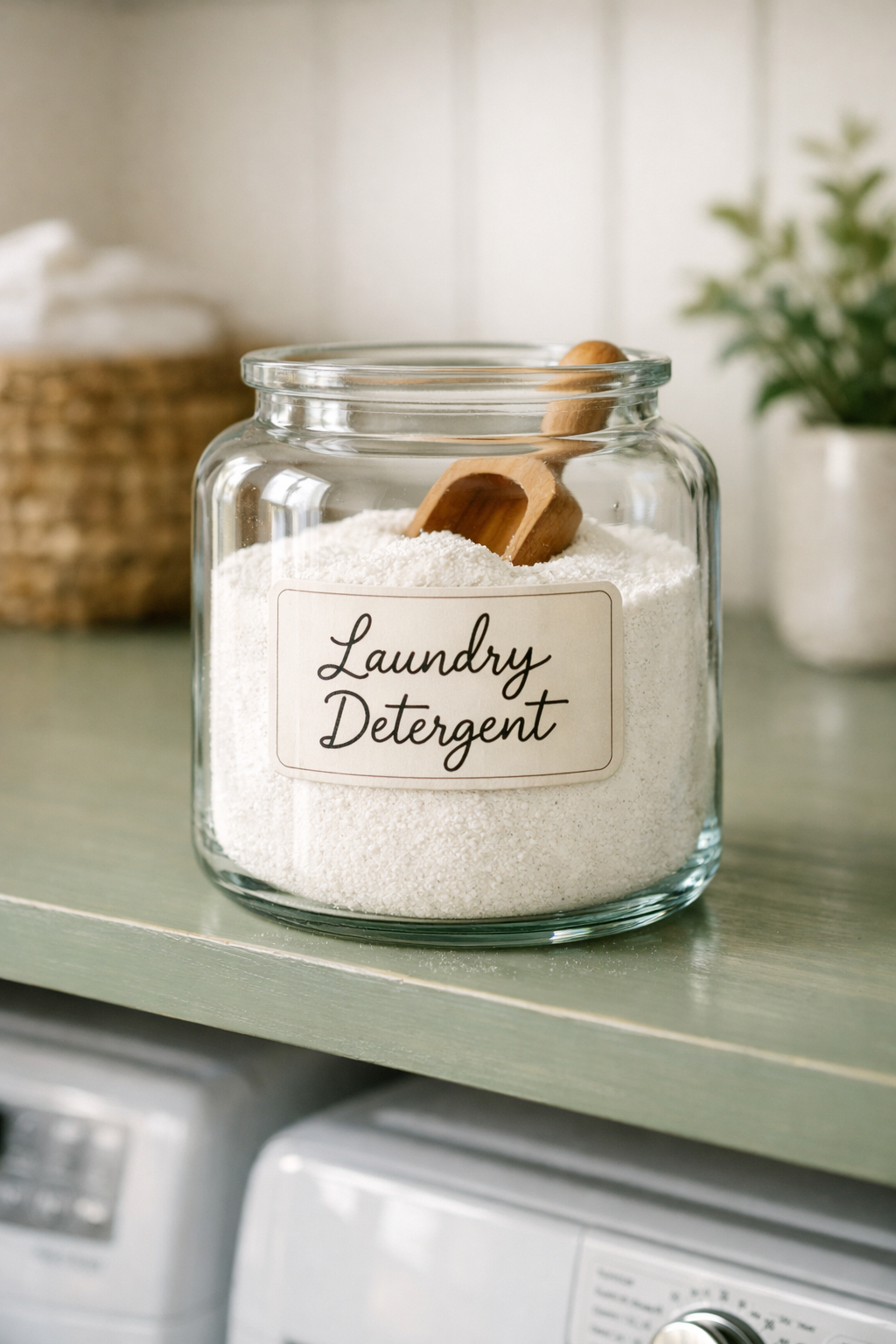
This is my kind of DIY: measure, mix, pour into a jar, and you’re done. It takes about 5–10 minutes once, and then you have a low-effort, budget-friendly option sitting in your laundry room ready to scoop.
Key notes
Why laundry is one of my favorite “low-tox” starting points
Laundry is a quiet but constant part of home life—clothes, towels, sheets, kids’ pajamas—touching skin all day. So if you want a swap that feels meaningful without flipping your entire lifestyle upside down, laundry is a great place to start.
For a lot of families, the biggest issue isn’t even the detergent “cleaning power”… it’s the extra stuff that can come with laundry products—especially heavy fragrance.
A note about fragrance
Fragranced products can contribute to VOCs (volatile organic compounds) in indoor air. The EPA lists short-term effects some people report from VOC exposure such as eye/nose/throat irritation, headaches, and nausea, and notes that health effects depend on the chemical and exposure level.
The American Lung Association also notes VOCs come from many everyday products and can cause symptoms like irritation, headaches, nausea, and dizziness, especially for sensitive people.
This isn’t meant to be scary. It’s just a “why” behind choosing simpler options if you (or your kids) do better with less scent and fewer extras.
Why I prefer a “no bar soap” DIY detergent
A lot of DIY recipes use grated bar soap. Some people love them! But others find soap-based mixes can leave residue over time or feel less predictable—plus I honestly do not want another chore (or another kitchen gadget) in my life.
This recipe skips bar soap entirely, which means:
- A simple powder that’s easy to store and scoop
- No grating, no food processor, no extra equipment
What I personally try to avoid in laundry products
This is not meant to be a scary list—just a practical filter when I’m choosing what comes into our home:
- Synthetic fragrance
- Chlorine bleach
- Dyes
- Phosphates
And it also makes the point that “natural fragrance” can still be a gray area, since fragrance blends aren’t always fully disclosed.
What to expect (so you’re not annoyed)
HE/front-load note: This recipe is described as low-sudsing and the original creator believed it should be fine in HE machines, though they did not personally test it in one. If you have HE/front-load, start with the smaller amount and adjust.
Low-sudsing is normal. This powder doesn’t make big bubbles, and that’s okay. Suds are not the same thing as clean.
It’s not meant to smell like perfume laundry. You can add essential oils, but keep it light—or skip entirely.
How to use it (busy mom version)
This is the best part: you do not have to overthink it.
- Regular load: ~1 heaping tablespoon
- Large/heavily soiled loads: add another scoop (they mention 2–3 tablespoons for very dirty work clothes).
Easy “extras” if you want them (optional)
- Fabric softener swap: add a little white vinegar in the rinse cycle
- Dryer sheet swap: wool dryer balls are an easy replacement
Laundry safety (quick mom reminder)
No matter how “clean” the ingredients are, laundry products should still be stored safely.
The American Cleaning Institute recommends keeping laundry products up, closed, and out of reach of children, especially single-load packets, and keeping products in their original containers and putting them away immediately after use.
And just to put a real number behind why this matters: as of March 31, 2024, poison centers managed 2,240 cases related to laundry detergent packet exposure in children 5 and under.
(That’s one reason I love reducing the “grab-and-eat-it” appeal of pods in general.)
Budget note (because we love a realistic win)
If you’re looking at it purely from a cost-per-load angle, this DIY powder is hard to beat: it’s been estimated at about ~$0.06 per load (6¢) when priced out as a batch recipe. By comparison, Tide PODS come out to about ~$0.26 per load ($19.94 ÷ 76 loads). Truly Free is about ~$0.40 per load ($19.99 ÷ 50 loads). And Molly’s Suds lands around ~$0.19 per load ($22.99 ÷ 120 loads). So even compared to “cleaner” store-bought options, DIY can be 3–6× cheaper per wash, especially if you’re consistent about using a true 1-tablespoon scoop.

DIY Natural Powder Laundry Detergent Recipe
What you’ll need
- Measuring cups
- Large bowl
- A jar with a lid (mason jar works great)
- A tablespoon scoop
Ingredients
- 1/2 cup Epsom salt
- 1 1/2 cups baking soda (sodium bicarbonate)
- 1 1/2 cups washing soda (sodium carbonate)
- 1/4 cup sea salt
- Optional: 20–25 drops essential oils
Instructions
- Add all dry ingredients to a bowl and mix well.
- If you use essential oils, add them slowly and stir thoroughly so the oils distribute evenly (no clumps).
- Pour into a jar, seal, and store in a cool, dry place.
How much to use
- 1 heaping tablespoon per regular load
- Add another scoop for larger/heavily soiled loads (up to 2–3 tablespoons for very dirty loads).
FAQs
Will this work in cold water?
Yes — this recipe is described as working in cold and warm washes.
Can I skip essential oils?
Absolutely. They’re optional.
Can I swap OxiClean for baking soda?
The recipe notes oxygen boosters can be used as a booster, but not as a replacement for baking soda since they serve different purposes.
Recipe Card: DIY Powder Laundry Detergent (No Bar Soap)
Makes: ~3¾ cups (about 1 jar) • Time: 5–10 minutes • Best for: simple, low-sudsing, budget-friendly laundry
Ingredients
- 1/2 cup Epsom salt
- 1 1/2 cups baking soda
- 1 1/2 cups washing soda
- 1/4 cup sea salt
- Optional: 20–25 drops essential oils (totally optional)
Instructions
- Add all ingredients to a large bowl and mix well.
- If using essential oils, add slowly and stir thoroughly to distribute evenly (no clumps).
- Pour into a jar with a lid and store in a cool, dry place.
How to Use
- Regular load: 1 heaping tablespoon
- Large/heavily soiled loads: 2 tablespoons (up to 3 for extra dirty loads)
Quick notes: For HE/front-load washers, start with 1 tablespoon and adjust if needed. Optional softener swap: a splash of white vinegar in the rinse cycle. Optional dryer sheet swap: wool dryer balls.